Garages have become extensions of our homes in addition to places to park the car. There have become our go-to place for projects that may be a little too dusty, smelly, or take up too much room in the home. If a project requires painting or gluing and it needs to sit and dry, an area set aside in the garage works great.

So garages are getting nicer, cleaner, bigger, and more attention is being paid to the lighting. Better lighting isn’t just to accommodate projects, but also to provide safety when you leave or return home. It’s nice to know when you return home after dark and press the garage door opener, the garage door goes up, the light turns on, and you’ve got the illumination to show the whole garage.
Choose LEDs for safety
We’ve all seen those horror movies when one of the characters turns on the light and it’s a dim, flickering fluorescent that doesn’t show what might be hiding in the corner. Then there’s that loud, annoying hum with some crackling thrown in so whatever is hiding in the corner can sneak up on the poor actor and, well, you know the rest.
One of the best benefits of LED lights is when you turn them on, they turn on. They don’t flicker and think about it and “warm up” gradually to what would be considered proper lighting.
Dimly lighted garages just invite accidents. You can trip on something that got moved while your car was out. There may be cords running along the floor for equipment charging in the garage. Imagine getting out of the car with groceries and snagging your foot on an extension cord — a disaster in the making.
If you dread climbing up that tall ladder and replacing the bulbs in the garage, LED bulbs generally last 25 times longer than incandescent bulbs.
Light up that workshop area
When you are working on an at-home project in the garage, you’d like a nice, bright workspace. Trade in those fluorescent tubes for LED tubes and you will assuredly get better, brighter light and a safer environment.
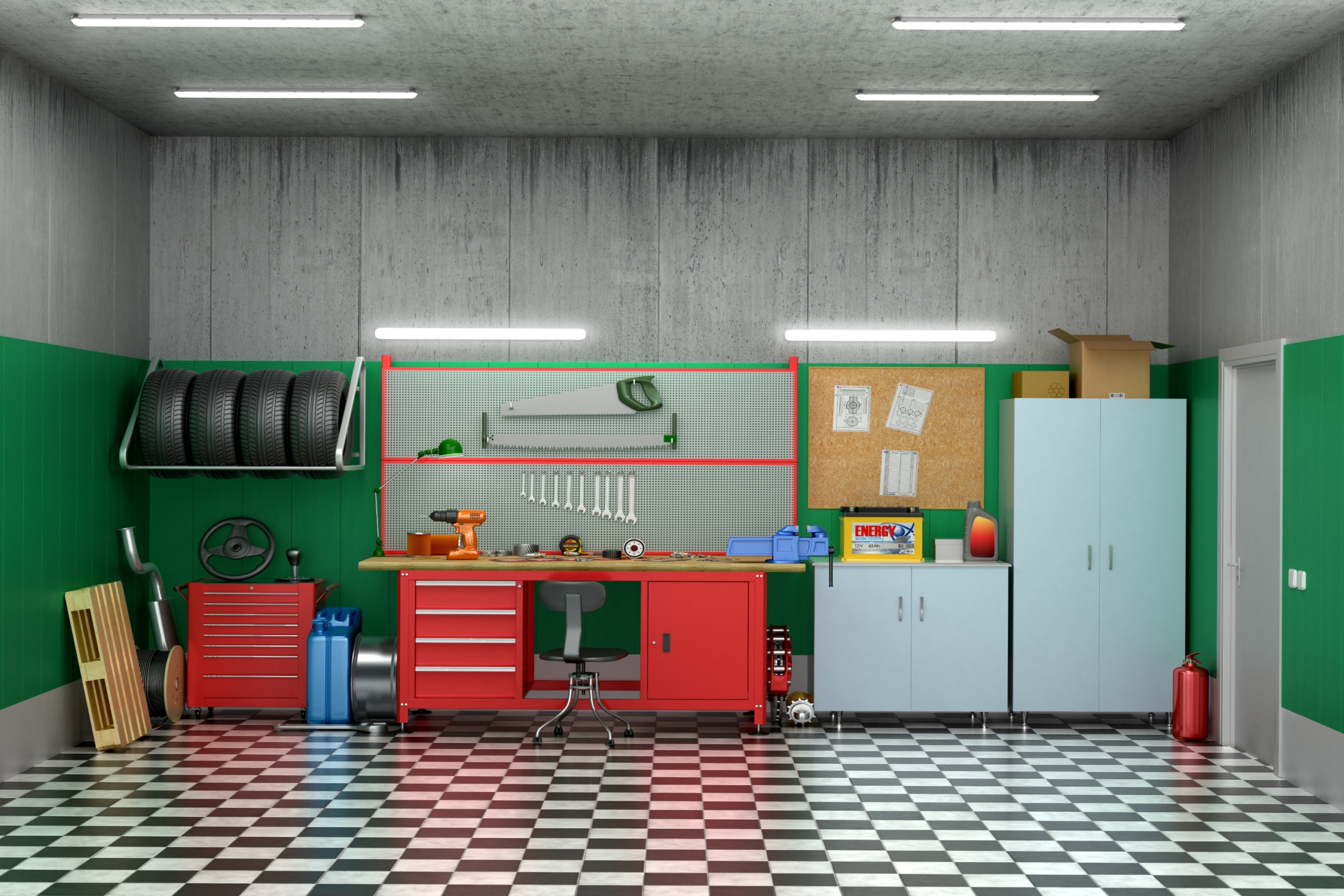
LED lights direct light downward so it will shine on your project. This is especially helpful if you are using woodworking equipment or small power tools or doing close, precision work.
For the general garage area you need about 50 lumens of illumination per square foot. In a workshop area, it should be about 300 lumens per square foot.
A quick word about lumens. If you’ve bought a light bulb recently, you may have noticed that the packaging has changed. Yes, it still says watts as a measurement on many of them, but it also has lumens.
Lumen is the brightness measurement while watt is the energy measurement. A 75 watt bulb is about 1100 lumens and a 40 watt bulb is about 450 lumens. So don’t be scared at a high lumen measurement.
There will also be a kelvin measurement. Kelvin measures the color temperature or “whiteness” of a bulb. LEDs are brighter than fluorescents, but here’s what you need to look for: Soft white is between 2700 and 3000K, bright white would be 3500 to 4100k, and daylight would be 5000 to 6500k.
LEDs come as bulbs or as tube lights so they are perfect for workshop areas. You can buy plug in LED tube lights that will fit in fluorescent fixtures.
More LED benefits
LED lights are made of a polycarbonate so if you happen to bang into them or knock them, they won’t shatter into thousands of tiny shards that will take forever to clean up. They radiate very little heat. You don’t get overheated working on a project and you don’t have to worry about heat from a bulb damaging something you might be working on, such as a paint finish or glue.
There are no harmful chemicals such as mercury in LED bulbs. LEDs do not emit infrared or ultraviolet light. They provide silent light so no humming, crackling, or electrical inference.
If you live in a cold climate, many fluorescents don’t work in temperatures below 50 degrees.
LED lights are 100% recyclable.

Garages aren’t just for parking anymore. They have become an extension of home space so it is important they are just as safe, and well lit as the rest of your home. You need lighting that illuminates instantly and is bright enough that everything in the garage is visible. Plus, you need lighting that helps you complete projects in garage work spaces. LED lighting is the best for this space.