Few types of lighting can elicit the pure drama of under-cabinet lights. Although typically used in kitchens to add extra light for meal preparation or to read recipes, under-cabinet lights can go beyond the kitchen to add function and style to other rooms in your home.
When used as accent lighting, under-cabinet lights add dimension, depth, and visual impact to any space, from showcasing objects inside glass-front cabinets to spotlighting unique architectural features like a cove ceiling. From functional lighting for a laundry room, workroom, or home office, to dramatic accent lighting for a living room wall unit, or master bedroom shelving, under-cabinet LED lighting can enhance virtually any room in your home.
 The 411 on under-cabinet LED lights
 The 411 on under-cabinet LED lights
As you can likely guess by the name, under-cabinet lighting refers to light fixtures commonly installed beneath kitchen cabinets to light up the countertops beneath. They are made to be hidden from view and easily blend into the room without taking away from the room’s style. Under-cabinet lights are highly prized among home buyers, making it a relatively simple and easy way to improve your kitchen’s look and feel while increasing the resale value of your home!
It’s important to choose the correct color temperature and CRI (color rendering index) to get the lighting result you desire with LED lights. The most popular CCT (correlated color temperature) ranges from 3000K to 4000K for kitchens. Any light below 3000K will result in a yellowish tinge that negatively impacts color perception, particularly in food preparation areas. Most home lighting is between 2700K and 3000K, so lighting above 4000K will make your kitchen lighting result in a noticeable color mismatch with the rest of your home.
If you’re planning on DIYing your under-cabinet LED lights, you should opt for plug-in installation styles. You don’t need electrical knowledge when opting for plug-in (or plug and play) lights. Still, there are some design limitations and drawbacks, mainly that they need to occupy electrical outlets that you may have wanted to keep free for countertop appliances, etc.
Hardwire installation are self-contained fixtures, meaning the components necessary to operate the light are contained within the unit and require a separate 120V power feed from the wall. Hardwire installation is more complex and should be left to professional electricians.
Under-cabinet lighting options
 Under-cabinet lighting options
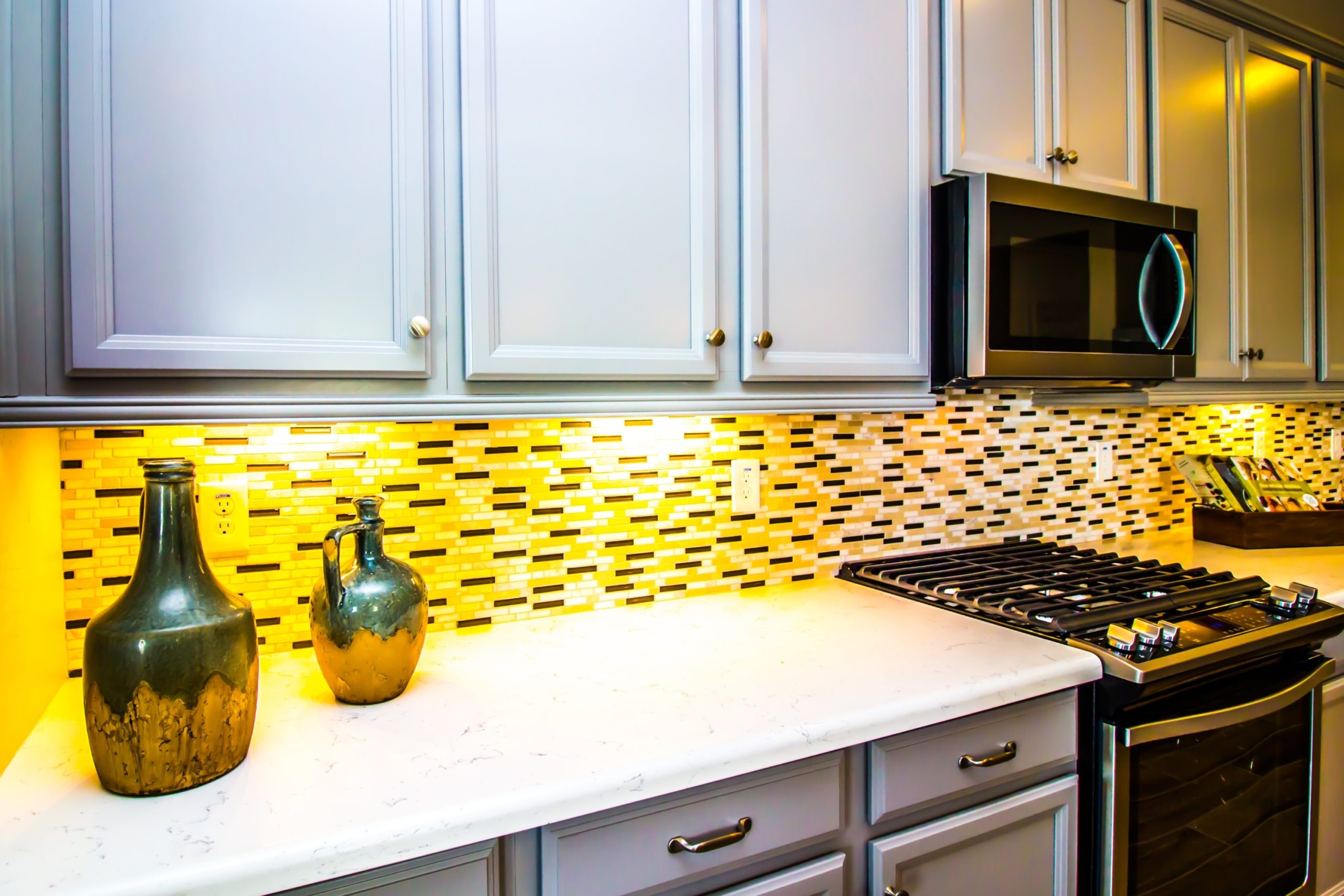
Low profile LED linear fixtures: The most widely-used under cabinet LED lights, they beautifully illuminate high-function kitchen zones like countertops, stoves, and sinks. Emitting light evenly across the entire length of the fixture, this type of under-cabinet lighting is used to brighten the shadows that cabinets can create and bathe the kitchen work area in light. Highly efficient and long-lasting, they throw off minimal heat and provide low operating costs. They are offered in standard lengths from 8” to 40” to work in almost any kitchen space.
LED puck lights: These small, compact lights provide ample, more focused light than linear fixtures while using low voltage. You can use them to light countertops, open shelving, glass-front cabinets, and more. Prized for their versatility, they can be surface mounted or recessed depending on the look you are trying to achieve.
LED puck lights are currently outselling traditional linear fixtures because they offer comparable performance at half the cost and just a fraction of the energy consumption. LED puck lights are also offered in battery-operated formats, eliminating the need to run wires and making installation a breeze.
LED light bars: With a lower profile than linear fixtures but a higher one than tape lighting, LED light bars are the perfect compromise under cabinet light choice. They generally deliver more light than tape and are easier to clean. Ultra-compact and simple to install, light bars work exceptionally well in tight corners and small spaces. They are still also linkable, letting you chain together multiple bars for L-shaped areas and tricky layouts. A great alternative to hot halogen and fluorescent under-cabinet systems, LED light bars are highly efficient, low maintenance, and give off very little heat.
LED tape lights: This unique strip lighting system comes in 16-foot reels and mounts easily to the underside of virtually any surface. Exceptionally versatile, LED tape lights can be custom cut to any length, connected for longer areas, and used for various applications, including: above cabinets, below counters, inside cove or tray ceilings, under kitchen islands, and more. Placed near the floor as toe-kick lighting, LED tape lights give a dramatic illusion of floating cabinetry.
Whatever your decor, whatever your lighting need, under-cabinet LED lights can add both style and functionality to your space. With many different varieties of under-cabinet LEDs available to you, there is sure to be one—or more—that work within your room’s dimensions and needs. Whether you want to tackle a DIY project over the weekend or are launching a major lighting overhaul, LED under-cabinet lights enhance the look of your room while increasing the value of your home.